

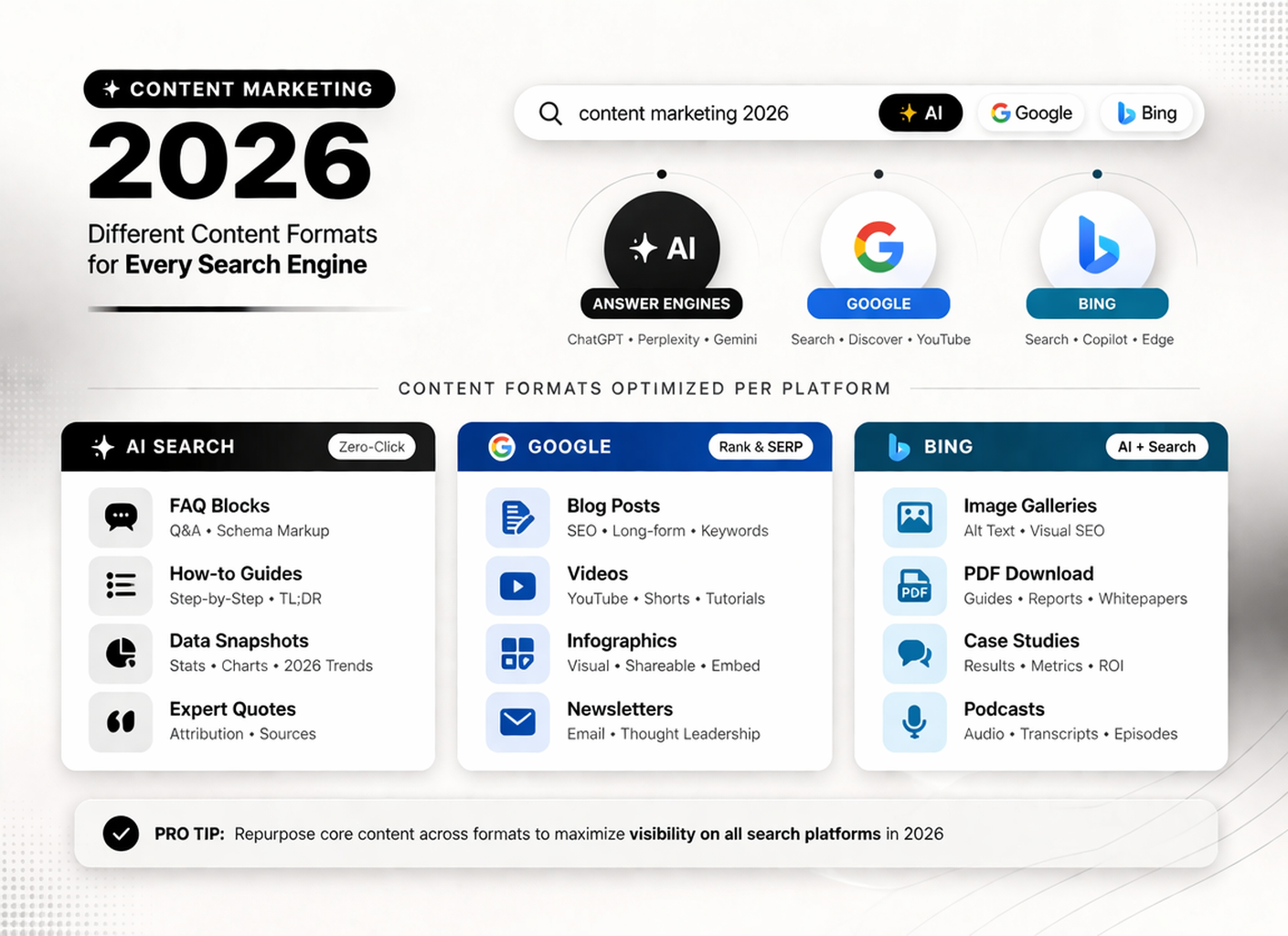
Key Takeaways:
- Publish smarter, not more. AI has made content cheap to produce. Strategy, originality, and trust are what set you apart now.
- Optimize for Google and AI search. ChatGPT, Perplexity, and Gemini pull from the same content pool. Structure your content so both can find and cite it.
- Prove your expertise. Author bios, real case studies, original data, and third-party mentions build the E-E-A-T signals that search engines reward.
- Be human on purpose. Readers skip generic content. Your real experience, opinions, and voice are the one thing AI can't replicate.
- Distribute relentlessly. Great content with no promotion is invisible. Spend more time getting it in front of people than creating it.
What Is Content Marketing, Really?
Content marketing is creating useful content that attracts the people you want as customers. Such content can be blog posts, videos, guides, case studies, social media posts, email newsletters. All of it. But here's where most people miss the point.
Content marketing is not about selling. It's about earning attention. You give value first. The sale comes later. Think about the last time you Googled a problem. Maybe "how to fix a leaky faucet" or "best CRM for small teams." You clicked an article. You read it. It helped you. And maybe, just maybe, you remembered the brand behind it.
That's content marketing doing its job.
Why Most Content Marketing Fails
Let's be honest. Most content out there is noise.
The problem: Businesses publish content because they feel like they should. They write about topics nobody searches for. They stuff keywords into articles without researching the search intent. They post once and forget about it.
Why it hurts: Every weak piece of content is a missed opportunity. Your competitors are getting the clicks, the trust, and the leads that should be yours. Meanwhile, your blog sits there collecting dust and hurts your rankings. Your website traffic flatlines. And your audience? They don't even know about your existence.
The fix: Stop creating content for the sake of it. Start creating content with a strategy behind it. Every piece should answer a real question, target a real keyword, match the search intent and serve a real business goal.
That's what separates content marketing from content publishing.
The Content Marketing Landscape in 2026
The world of content marketing has shifted. Big time. A few years ago, you could write a decent blog post, hit some keywords, and watch the traffic roll in. Those days are fading fast.
Here's what's actually happening right now.
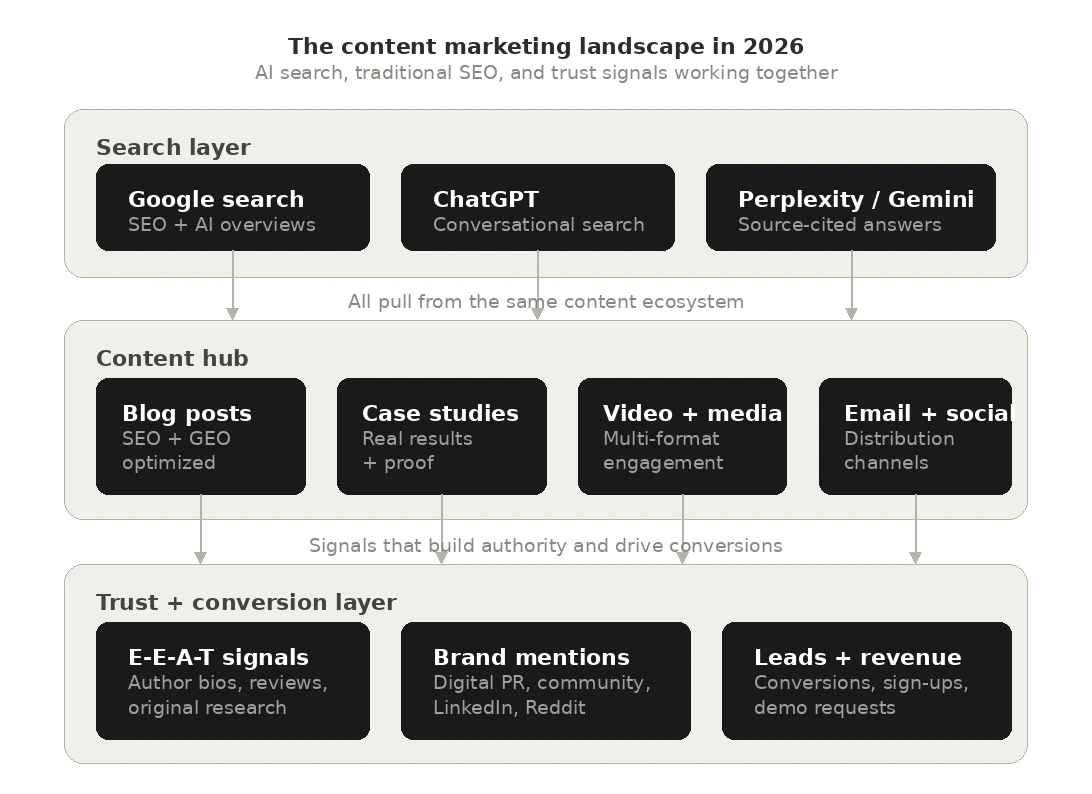
AI Search Is Changing Everything
Google isn't the only search engine anymore. People now ask ChatGPT, Gemini, and Perplexity for answers. And these AI tools don't just link to websites. They summarize, recommend, and sometimes answer without sending anyone to your site at all. This is called zero click search. The user gets their answer right in the search results or the AI chat. No click needed.
What does that mean for you? Your content needs to be good enough that AI tools want to cite it. That means clear structure, expert insights, and original data. If your content reads like a generic summary of other articles, AI will skip right over it.
Trust Beats Volume
For years, the content marketing playbook was simple: publish more. More blog posts. More landing pages. More words. In 2026, that playbook is dead.
When everyone can use AI to pump out 50 articles a week, volume means nothing. What matters now is trust.
Google calls it E-E-A-T: Experience, Expertise, Authoritativeness, and Trustworthiness. In plain English? Prove you know what you're talking about.
How do you prove it? Show your face. Share your real results. Include case studies. Add author bios with actual credentials. Link to original research. Get mentioned on other reputable sites.
The brands winning in 2026 aren't the ones publishing the most. They're the ones people actually believe.
The Human Touch Is a Competitive Advantage
Here's an ironic twist. As AI content floods the internet, being human becomes a superpower.
Readers are tired of generic, robotic articles that all say the same thing. They want personality. Opinions. Stories. The kind of content that could only come from someone who has actually done the work.
Think about your own experience. Would you rather read a blog post that sounds like it was written by a machine? Or one that feels like a smart friend explaining something over coffee?
Your unique perspective is your biggest content marketing asset. Use it. That's my two cents.
How to Build a Content Marketing Strategy That Works
Enough theory and thought sharing. Let's get practical. Here's a step by step approach to building a content marketing strategy that drives actual results.
Step 1: Know Your Audience (Like, Really Know Them)
This is where most businesses trip up. They write for everyone and reach no one. Before you create a single piece of content, answer these questions:
Who is my ideal customer? What problems keep them up at night? What questions do they type into Google or AI engines? Where do they spend time online? What kind of content do they prefer? Blog posts? Videos? Podcasts?
Example: Let's say you run a small accounting firm. Your ideal client might be a small business owner who Googles "do I need an accountant for my LLC" at 11pm on a Tuesday. That's your person. Write for them.
Step 2: Do Keyword Research (The Smart Way)
Keywords still matter. But not in the way they used to. Forget about stuffing your article with the same phrase 47 times. That hasn't worked for years. Instead, focus on understanding intent.
When someone searches "content marketing," what do they actually want? A definition? A strategy? Examples? Tools?
Map your keywords to real questions people ask. Then create content that answers those questions better than anyone else.
Some practical tips: Use tools like Ahrefs, SEMrush, or even Google's "People Also Ask" feature. Look for long tail keywords. "Content marketing strategy for small businesses" is easier to rank for than just "content marketing." Group related keywords together and cover them in a single, comprehensive piece.
Step 3: Create Content That Earns Attention
Here's the WIIFM principle in action: What's In It For Me?
Every reader who lands on your content is silently asking that question. If your article doesn't answer it within the first few seconds, they bounce.
So make every piece of content pass this test:
Does it solve a specific problem? Does it offer something the reader can use right now? Does it feel worth their time?
Good content marketing looks like this:
A SaaS company publishes a guide on "How to Reduce Customer Churn by 20%." It includes real data from their own platform, step by step tactics, and downloadable templates. That's valuable. That earns trust. And that generates leads.
Bad content marketing looks like this:
A SaaS company publishes "5 Tips for Customer Retention." Tip one: communicate with your customers. Tip two: offer good service. Thanks, Captain Obvious.
See the difference? I think anyone can.
Step 4: Optimize for Both Google and AI Search
This is the big one for 2026.
Your content needs to rank in traditional search results AND get picked up by AI tools like ChatGPT and Perplexity. Here's how.
For Google:
Use clear headings and subheadings (H2, H3). Include your target keyword naturally in the title, intro, and headings. Add internal links to related pages on your site. Make sure your page loads fast and works on mobile. Write meta descriptions that make people want to click.
For AI search engines:
Structure your content with clear question and answer patterns. Include FAQ sections with direct, concise answers. Add original data, stats, or examples that AI can cite. Use structured data (schema markup) where possible. Build your brand authority through mentions on other sites.
The key insight? Content that's well structured, genuinely useful, and backed by real expertise performs well in both traditional and AI search. You don't need two separate strategies. You need one really good one.
Step 5: Distribute Like You Mean It
Creating great content is half the battle. Getting it in front of people is the other half. Too many businesses hit "publish" and call it a day. That's not a strategy. That's a hope.
Here's a simple distribution plan:
Share every piece on LinkedIn, X, and any platform where your audience hangs out. Repurpose your blog post into a LinkedIn carousel, a short video, and an email newsletter. Engage in communities like Reddit, Discord, or industry forums. Not by dropping links, but by being genuinely helpful. Build an email list and use it. Email is still one of the highest converting channels in marketing.
Real talk: The best content marketers spend 20% of their time creating and 80% distributing (Pareto Principle). Flip those numbers and you'll wonder why your traffic never grows.
Step 6: Measure What Matters
Not all metrics are created equal. Page views are nice. But they don't pay the bills. Focus on the metrics that actually tie back to business goals.
Metrics that matter:
Organic traffic growth over time. Keyword rankings for your target terms. Leads generated from content (form fills, sign ups, demo requests). Conversion rate from content to customer. Engagement signals like time on page and scroll depth.
Metrics that don't matter (as much):
Social media likes. Bounce rate in isolation. Total word count published per month.
Track what drives revenue. Ignore the vanity metrics that get you nowhere.
Content Marketing Examples That Actually Work
Let's look at a few real approaches that can help you deliver results.
The "Hub and Spoke" Model
Pick a big topic. Create one comprehensive guide (the hub). Then create smaller, related articles (the spokes) that link back to it.
Example: Your hub is "Content Marketing Strategy" (this article, for instance). Your spokes might be "How to Do Keyword Research," "Email Marketing for Small Businesses," and "How to Write Blog Posts That Rank." Each spoke links back to the hub. The hub links out to each spoke.
This builds topical authority. Google loves it. AI search tools love it. Your readers love it because they can go deeper on any subtopic. Think of the structure as a spider web.
The "Original Data" Play
Nothing builds trust faster than original research. Run a survey. Analyze your own customer data. Share unique insights that nobody else has.
When you publish original data, two things happen. First, other sites link to you because you're the source. Second, AI tools are more likely to cite you because the information can't be found anywhere else.
You don't need a massive budget for this. Even a simple poll of your email list or social audience can produce data worth publishing.
The "Problem First" Approach
Start with the biggest pain point your audience faces. Build your entire content piece around solving it. This is the PAS technique in action:
Problem: Small businesses struggle to get found online.
Agitation: Every day without visibility means lost customers going to competitors who showed up first. Solution: A focused content marketing strategy that targets the right keywords, builds trust, and drives consistent inbound traffic.
When you lead with the problem, readers feel understood. They stick around for the solution. And they trust you because you clearly get their situation.
Common Content Marketing Mistakes to Avoid
Before wrapping up, here are the traps I see businesses fall into again and again.
Writing for search engines instead of people. If your content sounds like it was written to please an algorithm, readers will notice. Write for humans first. Optimize for search second.
Ignoring distribution. Great content with zero promotion is invisible content. Always have a plan for getting eyeballs on your work.
Being inconsistent. Publishing five articles in January and then going silent until June destroys momentum. Consistency beats intensity. One solid post per week beats a content dump every quarter.
Skipping the strategy. Jumping straight into writing without a plan is like driving without a map. You'll end up somewhere, but probably not where you wanted to go.
Not updating old content. Your best performing articles need regular updates. Fresh data, new examples, current links. Search engines reward content that stays current.
The Bottom Line
Content marketing in 2026 isn't about publishing more. It's about publishing smarter.
Focus on trust over volume. Optimize for both Google and AI search. Lead with your unique expertise. Distribute relentlessly. And always, always start with what your audience actually needs.
The businesses that treat content marketing as a strategic asset, not a checkbox, are the ones that will win. Not just this year. But for years to come.
Your content is your voice online. Make it worth hearing. And lastly, try to have as much fun as possible!
Frequently Asked Questions
Below are answers to common questions about content marketing.